
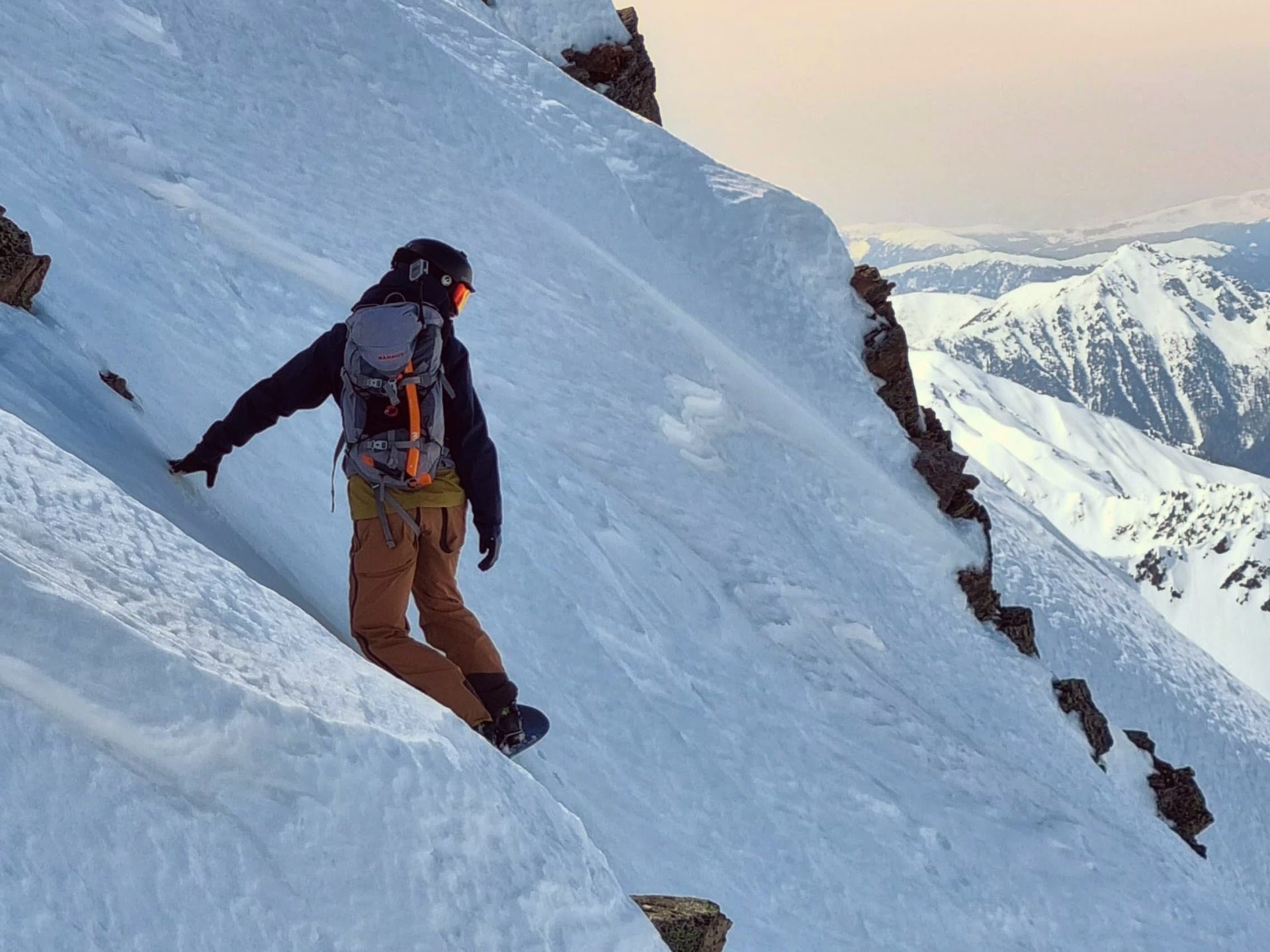
Before we discuss whether or not we can trust them with our lives, let's review some basic information about these backpacks. There are many names for them, the most common being avalanche backpack, airbag backpack, airbag backpack and the ABS backpack named after one manufacturer. Nowadays there are many types and their main function is to keep you up on the avalanche surface. It is not part of the compulsory avalanche equipment, but it can be very useful
How does it work?
The size of the inflatable airbag varies between 150 and 200 litres, depending on the system and manufacturer. This extra volume added to the volume of the body creates a much greater buoyancy force, helping you to stay on top of the avalanche. A good example of this is breakfast cereal, in the jar or bag when you start shaking it, the larger pieces go to the top and the smaller pieces go to the bottom.

Is it really as good as it is in the public mind?
According to several statistics, these backpacks would save between 35 and 81 people per 100 people. On average, 64. So of those who would otherwise have died, just over half would have a chance of survival with a deployed airbag. These figures are calculated from many years of accident data. Descriptions on the internet of a 97% survival rate should be treated with strong reservations, as a high percentage of avalanche accidents (around 81%) are survived by the people involved by default, e.g. they slip out, get stuck in a tree, the avalanche is too small to be buried or they are rescued by their beacon. The survival of the remaining 19% or so depends heavily on the terrain, i.e. how rocky, wooded, how big the avalanche is or whether there is a trap. In the case of a field trap, even a rucksack with an airbag is no guarantee of survival and complete burial can easily occur.

There are basically two broad categories of airbag backpacks. There are the electric systems that use a fan to fill the airbag with air. The other is a fully mechanical solution, where a charge from a compressed air cylinder inflates the airbag.
Compressed air activated system
This is the old and traditional system. Bags from BCA, Mammut, Ortovox and ABS manufacturers almost all work with bottles. By pulling the release lever, through various mechanisms, compressed air flows out of the cylinder and inflates the airbag(s). There are also disposable and refillable cylinders that can be refilled in a dive shop or by a firefighter. There are the traditional metal or aluminium cylinders and the lighter carbon ones. Cylinders can also differ according to the filling material, such as compressed air, carbon dioxide or nitrogen.
The advantages of this system are that they are lighter than their electric counterparts and inflate slightly faster (the difference of 1-2sec is not relevant). There are no electronics, so there is less chance of failure. However, the disadvantage is that it is more cumbersome to transport a compressed air cylinder in an aircraft. Separate documents have to be downloaded from the manufacturer's website and even then there is no guarantee that the cylinder will be released. Another disadvantage is that the system can only be activated once with a filled cylinder, so there is no possibility of a free trial.

Electrical system
The electric systems use powerful fans to inflate the airbags and keep them inflated for a few minutes. After deployment, the fan recharges a few more times to ensure that if the airbag is damaged (not torn in two), it continues to perform its life-saving function. The fan is powered by lithium-ion, lithium-polymer, AA lithium-ion or AA Alkaline batteries, depending on the manufacturer and system. Newer systems use a so-called super capacitor to reduce the extra weight due to the battery.
Manufacturers guarantee these systems to work down to -30 degrees Celsius, so in the Alps you don't have to worry that the cold won't get it working when you need it.
Some manufacturers' bags are able to deflate within 3-4 minutes after deployment, leaving a huge air cavity under the snow. This helps the user to have usable air for as long as possible after a possible burial, thus increasing the chances of survival.
The advantage of the electric system is that the airbag can be deployed up to 2-3 times with a single charge. This way you can test the system at any time before use, and in the worst case, you don't have to go to the store for a new bottle after an accidental/ direct deployment, just refill it and get on with your day. Whichever bag is able to suck the airbag off after use will leave a larger air cavity, increasing the chances of survival. Home rechargeable batteries. They are less of a hassle to transport by air than cylinder systems, but you should check the manufacturer's website for transport conditions and documentation.
The disadvantage is that they are heavier than their compressed air counterparts, but newer super condenser systems are now able to compete with them. More failure potential due to the electrical system and fan.

With this information, you will now be able to weigh up and decide for yourself which system you prefer. However, it is very IMPORTANT to remember that an airbag backpack is not a substitute for basic avalanche equipment! So a beacon, probe and shovel are the basic equipment for a snowy trek, and an airbag backpack can be a useful addition. Don't be under the illusion that a backpack will save you from anything! Hike and route planning, interpretation of the avalanche report and analysis of the conditions on the ground, i.e. PREVENTING a possible avalanche accident, is the key!
If you are interested in this topic in more depth and want to be safe on the mountain in winter, come to one of my avalanche courses. There are 3-4 sessions per season and you can find more information here: https://kalandozasok-ausztriaban.hu/lavina-tanfolyam/
